Tuesday, August 28, 2012


Wednesday, December 28, 2011
Monday, July 18, 2011
Cananga flower distillation
Cananga flowers are hydrodistilled for 60 hours. Clove Wood is used to heat the direct fire still. The aroma is similar to that of Ylang, but is always distilled as a whole oil unlike Ylang which is fractioned during distillation.
Sunday, June 12, 2011
Hands on Distillation Workshop July 30
Hands on Distillation Workshop
When: July 30 - 9am to 5pm
Where: The Sellwood Boutique Essential Oil Distillery - Portland Oregon
Participants will learn the history of distillation, and the usage of various types of equipment used to distill essential oils and hydrosols
During the course of the day, we will learn and experience the use of:
100 gallon stainless steel steam distiller
35 gallon stainless steel water/steam distiller
40 liter rotating column copper Alembic distiller
15 gallon copper water/steam distiller
5 liter hydrodistiller
We will have a continental breakfast with coffee/tea/juice, donuts and bagels during and after the morning lecture. We will then commence distillation.
We will also have a "working pizza lunch".
We always have fun, with participants from all over the USA and some international guests as well!
The cost is $150
Spend the day with The Guerilla Distiller - Robert Seidel, Master Distiller since 1977.
Robert is experienced in distilling a variety of plant material including Lavender, Lavindin, several varieties of Sage - including Sacred White Sage, Oregano, Thyme, Helichrysum, and a wide variety of coniferous needles and woods and much more.
If you wish to join us, please call 800.729.5912 or email Samantha
Distillation Season is Here
to see the variety of distillation equipment we offer please click here
Follow us on Facebook
Friday, March 04, 2011
Thursday, February 10, 2011
Distillation postings on Facebook
I have posted some distillation tidbits on our Facebook page, along with some photos.
To date, I have distilled:
Douglas Fir
Noble Fir
Grand Fir
Incense Cedar
Ponderosa Pine
We also plan to distill many other things found growing in the understory of the Northwestern Forests.
Salal, ceanothus, various mosses and lichen, and whatever else is brought to me. This is a very interesting project, a cooperative venture among small woodlot owners, large lot owners, Christmas tree farmers and more. The goal is to produce value added products. Already, the Coop has managed to sell bundled fire wood locally through high end grocery stores.
Wednesday, January 26, 2011
Certified Organic Processor of Essential Oils

Sunday, September 05, 2010
Harvesting Lavender for Distilling Lavender Reserve
Saturday, August 07, 2010
Western Juniper
Sunday, April 25, 2010
Distilling Incense Cedar Leaf
 I managed to locate an excellent source for wild crafted aromatic raw materials. This is very exciting to me, as it opens a door for access to some very interesting plants, some of which I've wanted to distill for a very long time. Included in that list is Wild Ginger (Asarum canadense), Arrow Leaf Balsam Root (Balsamorhiza sagittata), Pipsissewa - Prince's Pine (Chimaphila umbellata) and of course one of my favorites, Incense Cedar (Libocedrus decurrens-- aka Calocedrus decurrens)
 I started distilling a batch of Incense Cedar Leaf. The leaf had been gently dried and there was minimal stem material. This is very good, because the twigs are unproductive and take up room and cost energy. I distilled for three hours and obtained less than 0.5% yield. Then it dawned on me that I had made an error.
As with all conifers, the scales of the "leaf" of the Incense Cedar are covered with a waxy coating. In order to break the coating down and get at the essential oils the coating protects, the "leaf" must first be soaked in room temperature water.
I turned off my distiller, and left the steam soaked plant material to sit overnight. When I distilled the next morning, the essential oil flowed easily.
I finally ended up with a 1.4% yield of essential oil and lots of interesting hydrosols.
When I do my next run of Incense Cedar Leaf, I will add copper to the system to reduce the sulfurous "still note". The last time I distilled Incense Cedar was in a copper still and the oil was "sweet" right from the beginning. I will also soak each batch for at least 12 hours prior to distillation.
Right now the oil and waters are breathing, like a fine wine.
I hope in the future to be able to increase the percent yield to between 1.5 and 2.0 %.
I started distilling a batch of Incense Cedar Leaf. The leaf had been gently dried and there was minimal stem material. This is very good, because the twigs are unproductive and take up room and cost energy. I distilled for three hours and obtained less than 0.5% yield. Then it dawned on me that I had made an error.
As with all conifers, the scales of the "leaf" of the Incense Cedar are covered with a waxy coating. In order to break the coating down and get at the essential oils the coating protects, the "leaf" must first be soaked in room temperature water.
I turned off my distiller, and left the steam soaked plant material to sit overnight. When I distilled the next morning, the essential oil flowed easily.
I finally ended up with a 1.4% yield of essential oil and lots of interesting hydrosols.
When I do my next run of Incense Cedar Leaf, I will add copper to the system to reduce the sulfurous "still note". The last time I distilled Incense Cedar was in a copper still and the oil was "sweet" right from the beginning. I will also soak each batch for at least 12 hours prior to distillation.
Right now the oil and waters are breathing, like a fine wine.
I hope in the future to be able to increase the percent yield to between 1.5 and 2.0 %.
 Cant' wait to distill Wild Ginger and Arrowleaf Balsamroot!

Wednesday, January 27, 2010
Distillery Opens in Sellwood
 Finally!! We've opened our distillery in Sellwood. Sellwood is on the south side of Portland, Oregon. It's a great neighborhood, about 4 miles from downtown Portland.
We have expanded our warehouse an additional 7200 square feet. Within this additional space is our new distillery. This is a small scale boutique distillery with capabilities for direct steam and water/steam distillation.
In addition to serving as a functional distillery, this is also a show room for interested parties to view the various types of distillation apparatus we offer for sale.
Our newest piece of equipment is a 35 gallon water/steam distiller, currently priced at $8780 US FOB Oregon.
This is a self contained distiller that operates using propane as fuel for the burner. The water level is regulated with a float valve, so you never have to worry about running out of water. The condenser is also regulated for temperature so that you can set it to the temperature that you desire your distillate to be.
Finally!! We've opened our distillery in Sellwood. Sellwood is on the south side of Portland, Oregon. It's a great neighborhood, about 4 miles from downtown Portland.
We have expanded our warehouse an additional 7200 square feet. Within this additional space is our new distillery. This is a small scale boutique distillery with capabilities for direct steam and water/steam distillation.
In addition to serving as a functional distillery, this is also a show room for interested parties to view the various types of distillation apparatus we offer for sale.
Our newest piece of equipment is a 35 gallon water/steam distiller, currently priced at $8780 US FOB Oregon.
This is a self contained distiller that operates using propane as fuel for the burner. The water level is regulated with a float valve, so you never have to worry about running out of water. The condenser is also regulated for temperature so that you can set it to the temperature that you desire your distillate to be.
Monday, February 02, 2009
Sunday, July 13, 2008
Greetings from Naxos
Wednesday, September 26, 2007
White Sage
 I managed to distill about 445 pounds of Sacred Sage (Salvia apiana). The material was dry (perhaps two years old) with stems and leaves. Because of its age, I wasn't certain what the results would be. I've been pleasantly surprised.
Because the material was dry, distillation went very quickly. Each batch of near 100 pounds only took about 1/2 hour.
I distilled this oil using my 100 gallon stainless steel distiller.
I obtained a 3.5% yield of a pale yellowish oil.
Currently, the oil is being allowed to breathe, to eliminate the still note.
The aroma is very pleasant, characteristic of White Sage. I believe it will sweeten up nicely. It will be interesting to see the analysis of this oil. I'm curious to see the difference between this oil, distilled from dry (old too) leaf and stem, and oil distilled from freshly harvested material.
The Lavandin oil I distilled in July is ready to be bottled. This Lavandin was grown in Scholls, Oregon at Mountainside Lavender.
I managed to distill about 445 pounds of Sacred Sage (Salvia apiana). The material was dry (perhaps two years old) with stems and leaves. Because of its age, I wasn't certain what the results would be. I've been pleasantly surprised.
Because the material was dry, distillation went very quickly. Each batch of near 100 pounds only took about 1/2 hour.
I distilled this oil using my 100 gallon stainless steel distiller.
I obtained a 3.5% yield of a pale yellowish oil.
Currently, the oil is being allowed to breathe, to eliminate the still note.
The aroma is very pleasant, characteristic of White Sage. I believe it will sweeten up nicely. It will be interesting to see the analysis of this oil. I'm curious to see the difference between this oil, distilled from dry (old too) leaf and stem, and oil distilled from freshly harvested material.
The Lavandin oil I distilled in July is ready to be bottled. This Lavandin was grown in Scholls, Oregon at Mountainside Lavender.
Tuesday, August 07, 2007
Distilling Season
 It's been a busy distilling season.
While at Mountainside Lavender
I managed to distill 10 batches of Lavandin. The yield from each batch was approximately 2.5 pounds of oil, and lots of hydrosols.
Hood River Lavender had a fun Lavender festival. There was wine, music and lots of boots selling hand made products. The weather was perfect. I had a table offering our hand hammered copper Alembic distillers.
I also managed to distill some of our "Population Lavender" this is lavender (Lavendula angustifolia) which was grown from seed. Because the lavender was grown from seed, there is quite a bit of genetic diversity in the plants. Most lavender farms grow their lavender from clones, which offers no genetic diversity. The resulting oil from our genetically diverse crop is exquisite.
We sell this beautiful essential oil here.
Later this week I will be distilling Sacred White Sage
It's been a busy distilling season.
While at Mountainside Lavender
I managed to distill 10 batches of Lavandin. The yield from each batch was approximately 2.5 pounds of oil, and lots of hydrosols.
Hood River Lavender had a fun Lavender festival. There was wine, music and lots of boots selling hand made products. The weather was perfect. I had a table offering our hand hammered copper Alembic distillers.
I also managed to distill some of our "Population Lavender" this is lavender (Lavendula angustifolia) which was grown from seed. Because the lavender was grown from seed, there is quite a bit of genetic diversity in the plants. Most lavender farms grow their lavender from clones, which offers no genetic diversity. The resulting oil from our genetically diverse crop is exquisite.
We sell this beautiful essential oil here.
Later this week I will be distilling Sacred White Sage
Tuesday, May 01, 2007
In The News
Businessman enjoys sweet smell of success
In 1977 Robert Seidel started a business that made a lot of scents but not much money.
In fact Seidel, 56, says the first few years he made no money at all.
But 30 years later, The Essential Oil Co., a wholesaler of essential plant oils based in the Sellwood neighborhood of Southeast Portland, is doing quite well.
Last month he shared trade secrets with students at Clackamas County's Tree School, an annual program targeted to those in forestry and timber management fields sponsored by the Oregon State University Extension Service, Clackamas Community College and local forestry groups.
"Oils are a value-added product," Seidel said. "When you harvest a tree you can collect the branches that you cut off and distill the oil."
The essential oils Seidel sells are used by large manufacturing companies and individuals throughout the world in soaps, cosmetics, candles, lotions and other consumer products.
Seidel's considered a pioneer and a respected expert and distiller in the aromatherapy industry, according to those who buy from him.
He loves talking about the distillation process he began learning as a college student in New York more than 30 years ago.
In those days Seidel was studying forestry resource management. He became enamored of the smell of balsam fir and began researching methods for capturing the fragrant oils.
He discovered that few people knew how to extract the oils, and many companies that claimed to be using essential oils in their products were fabricating the scents in laboratories.
Using information he found in a couple of old books and a lot of trial and error, Seidel began distilling essential oils from Douglas fir and later from the needles, branches, leaves, stems and petals of other plants.
He used a distiller made from a refrigerator coil and a pressure cooker to produce a small quantity of peppermint and a few other oils. He also began buying and selling small amounts of essential oils.
"There were very few people then who knew what an essential oil was," said Seidel, who worked full time as a plywood inspector for a trade association in the late '70s. "So there was me and about five hippies that I sold to."
n 1981, when the timber industry foundered and Seidel lost his job, he turned his passion for essential oils into a full-time profession. He also drove a cab for a while and took other jobs to pay the bills while building his business.
Initially, the company sold oils through a catalog. Now customers from around the world buy pounds of his products from the Internet. He also sells to a loyal group of regional customers, many of whom come to the sample bar at his Sellwood office and warehouse to get a whiff of the different aromas.
Once they meet Seidel, customers are likely to come back, said Joe Orcutt, a lavender grower from Hood River who has purchased oils and a distiller from Seidel's company.
Seidel exudes passion for plants and their essence. His products, though sometimes more expensive than others, are of the highest quality, Orcutt said.
The quality is in part because Seidel "goes out in the field with the growers," said Heather Michet, an aromatherapist from Sandy who buys about 90 percent of her scents from Seidel's company.
Travel is part of the allure of the job for Seidel. He spends weeks every year on the road.
"I travel to distillers and visit with them to make sure they are doing what they say they are doing. I want to see the plants growing," Seidel said. "I like to travel and meet people, and it's a great way to see the country not just as a tourist."
In a couple of weeks Seidel will be in Fiji meeting with sandalwood growers. He's visited Egypt and India in search of jasmine and met with rosemary growers in Tunisia and Israel.
When he's not creating his own line of essential oils, Seidel is helping others distill theirs through a steaming process that vaporizes the oil before cooling it back to a watery liquid that leaves the oil on top. He also builds and sells distillers.
When time allows, Seidel attends area festivals and events to demonstrate the distillation process and teach others how to do it.
"I like it every time I distill," he said. "You put in the raw material and you get this beautiful smelly oil out. It's like capturing the essence of the plant."
Polly Campbell:p2campbell@comcast.net
From The Capital Press:
Essential oils can be distilled from foliage
Process works well for lavender growers, company president says at Tree School
Mateusz Perkowski
Capital Press Staff Writer
Out of the countless things that can be made from conifers, toiletries are seldom at the top of the list.
While trunks are commonly used for lumber, it's possible to extract value-added products from foliage as well, said Robert Seidel, president of the Essential Oil Co. in Portland.
Conifer needles contain essential oils that can be distilled and sold in liquid form or used in lotions, soaps, perfumes, aromatherapy candles, balms and similar goods.
Although it's unfeasible for family forest owners or Christmas tree growers to generate enough essential oil to compete on a wholesale level, they can find a retail niche for smaller amounts, Seidel explained.
"If you're selling it directly to the consumer, then you can make some money at it," he said. Seidel gave a distilling demonstration at 2007 Clackamas Tree School in Oregon City on March 24.
The process has been working well for lavender growers in Oregon and Washington, who add essential oil and flowers to various personal care products, he said.
Each year, Seidel travels to lavender farms with his mobile still; he is paid for his efforts with a portion of the oil he extracts. Such an arrangement also may be practical with other materials besides lavender, but only if it doesn't require traveling long distances, he said.
Growing lavender for essential oil is much more common, but in terms of cultivation, tree farmers have a distinct advantage: unlike lavender flowers, conifer foliage is simply a byproduct and doesn't require special maintenance or irrigation, Seidel said.
Christmas tree growers can gather material left over from pruning, while woodland owners can save branches they've cut from logs, he said. "One tree is going to have a lot of material," he said.
At the wholesale level, one pound of essential oil sells for $10 to $25, he said. Distilling 100 pounds of raw conifer material yields about half a pound of oil and requires industrial-sized equipment that costs at least $25,000.
Obviously, a full-blown commercial venture would not be economical for tree farmers, Seidel said. Even if someone invested in a commercial plant, producers in Central and Eastern Europe would be able to undercut them on price, he said.
Small stills, on the other hand, only process about 10 to 12 pounds of raw material at a time, producing an ounce of oil or less after three hours of boiling. Such stills cost $1,500 to $3,000, but they also can be built from inexpensive metal objects.
Seidel fashioned his first still from a pressure cooker and a copper coil. Also, they can be heated with a propane burner or wood, rather than a costly boiler.
"There are some interesting configurations," he said. "A guy can get creative."
Although the amount of oil these stills produce is minute, a little bit goes a long way when it's diluted in personal care products - for example, a pound of pre-made, unscented soap requires only one-sixteenth of an ounce of oil, Seidel said.
To expedite production, it may be wise to team up with someone - a wife or daughter, for instance - so that one person is in charge of distilling and the other handles blending and packaging, he said.
The organic and natural personal care industry generates about $5 billion a year in sales and is expected to grow to $11 billion by 2009, according to the Natural Marketing Institute.
In such an expanding and competitive market, distilling one's own essential oil can be a big selling point, particularly if consumers can see how the product is derived from raw needles in a still, said Seidel. "People like to see how things are done," he said.
This marketing angle has allowed Seidel to sell essential oil his company has distilled for up to $15 a half-ounce, he said. "With retail, the sky's the limit."
Distilling essential oil from tree needles isn't going to make anyone rich or generate enough money to retire on, but Seidel believes it's a viable way to garner some value from a waste material - and have some fun at the same time.
"Every time I see oil come from the distiller, I'm amazed," said Seidel. "It goes back to the old alchemy days."
Mateusz Perkowski is based in Salem. His e-mail address is mperkowski@capitalpress.com.
Saturday, March 10, 2007
Distilling Frankincense Gum

 I managed to obtain some fresh prime Olibanum (Frankincense) Gum (Boswellia carterii) from Somalia.
I have distilled Gum Olibanum before, in my 100 gallon stainless steel steam distiller.
It was a successful distillation, but an incredible mess. Frankincense Gum is actually a gum/resin. Partially water soluble. Inside the steam distiller, the gum would melt from the heat and water. Globs of gum covered the steam spreader bars. I normally distill plants such as lavender at about 1 pound of pressure. For this gum, I had to boost the pressure to 5 lbs, to keep the spreader bars clear. In the steam distiller, the gum bubbles up and expands. If too much gum is placed in the still, the gum will bubble up and possible clog the condenser.
I managed to obtain some fresh prime Olibanum (Frankincense) Gum (Boswellia carterii) from Somalia.
I have distilled Gum Olibanum before, in my 100 gallon stainless steel steam distiller.
It was a successful distillation, but an incredible mess. Frankincense Gum is actually a gum/resin. Partially water soluble. Inside the steam distiller, the gum would melt from the heat and water. Globs of gum covered the steam spreader bars. I normally distill plants such as lavender at about 1 pound of pressure. For this gum, I had to boost the pressure to 5 lbs, to keep the spreader bars clear. In the steam distiller, the gum bubbles up and expands. If too much gum is placed in the still, the gum will bubble up and possible clog the condenser.

Friday, August 04, 2006
Distilling at the US Botanic Gardens, Wash DC
 At the end of July, I was invited to the US Botanic Gardens in Washington D.C. to demonstrate distillation for the general public.
The Botanic Gardens are very beautiful, containing specimens of plants from all over the world. At the time I was there, the Ylang Ylang Tree (Cananga odorata) in the gardens was flowering. What a fabulous aroma. A flowering branch was placed in a vase for all to enjoy.
At the end of July, I was invited to the US Botanic Gardens in Washington D.C. to demonstrate distillation for the general public.
The Botanic Gardens are very beautiful, containing specimens of plants from all over the world. At the time I was there, the Ylang Ylang Tree (Cananga odorata) in the gardens was flowering. What a fabulous aroma. A flowering branch was placed in a vase for all to enjoy.
 and the loss of a bit of color, the buds were still laden with oil. The distiller I used was one that I designed myself. A Stainless Steel table top distiller. It was designed to use either gas or electicity (external hotplate). We used a small 10,000 btu butane burner, which worked like a charm. I used about one small can of butane per batch. many people from all over the world stopped by to see what I was doing and ask questions. The most frequently was "Where is the restroom?" followed by "Are you making coffee?" Most people had never witnessed the distillation of essential oils. There was a great deal of fascination in the process. Once I filled the still and started cooking, the whole room was filled with the aroma of "lavender".
  This drew people to discover the source of the aroma. I packed the distiller as full as I could with lavandin flowers along with the stems. The distiller has a total capacity of one cubic foot. This equates to 28.4 liters or 7.5 US gallons.
 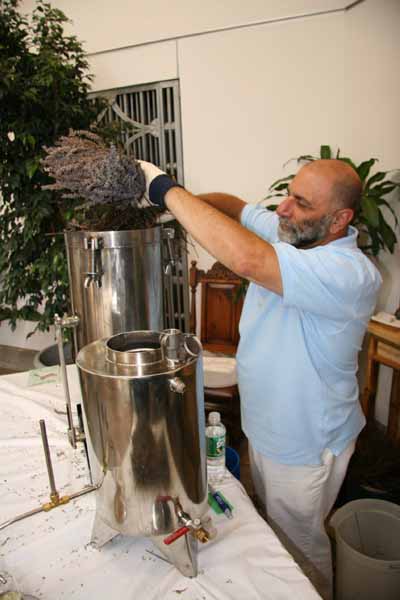 During past distillations in a similar distiller I was able to obtain 5.5 ounces of oil per batch, with distillation times up to 4 hours. For demonstration purposes I reduced the distillation time. I was still happy with the yield despite the reduce distillation time (about 1.5 hours) When distilling 65% of the oil you will obtain s distilled during the first 25% of your distillation time. The oil flow diminishes with time as the plants are exhausted.
Once the distiller was packed with flowers, I added water about 1/3 the way up the inside of the retort (the distilling pot). This distiller is equipped with a sight glass so that I can monitor the water level inside the distiller. Lavandin is hydrophilic and will absorb sorm of the water in the distiller.
The lid is then put in place, and the stainless hose coming from
During past distillations in a similar distiller I was able to obtain 5.5 ounces of oil per batch, with distillation times up to 4 hours. For demonstration purposes I reduced the distillation time. I was still happy with the yield despite the reduce distillation time (about 1.5 hours) When distilling 65% of the oil you will obtain s distilled during the first 25% of your distillation time. The oil flow diminishes with time as the plants are exhausted.
Once the distiller was packed with flowers, I added water about 1/3 the way up the inside of the retort (the distilling pot). This distiller is equipped with a sight glass so that I can monitor the water level inside the distiller. Lavandin is hydrophilic and will absorb sorm of the water in the distiller.
The lid is then put in place, and the stainless hose coming from  the lid (bird's beak) is then attached to the condenser. Between batch changes the distiller is very hot. It's adviseable
  to wear gloves druing this operation. Better safe than sorry. Once everything is attached, the lid is tight and the condenser filled with water, I'm ready to start cooking. It took about 1/2 hour for the water to come to a boil. The first oils started flowing about fifteen minutes later.
The butane gas burner was a pleasure to use. It enabled me to reduce the temperature once the distiller came to a boil, which in turn helps to reduce fuel consumption. Once the distillate started to flow from the condenser it was captured in my Florentine separator, my Essencier. This is a valuable tool for the small scale distiller.
to wear gloves druing this operation. Better safe than sorry. Once everything is attached, the lid is tight and the condenser filled with water, I'm ready to start cooking. It took about 1/2 hour for the water to come to a boil. The first oils started flowing about fifteen minutes later.
The butane gas burner was a pleasure to use. It enabled me to reduce the temperature once the distiller came to a boil, which in turn helps to reduce fuel consumption. Once the distillate started to flow from the condenser it was captured in my Florentine separator, my Essencier. This is a valuable tool for the small scale distiller.  It permits automatic separation of the distillate waters (hydrosols) from the essential oils. Although the process is simple, once it's understood, many people were mystified as to what was happening. I explained the process from beginning to end about two hundred times during the day. I didn't mind it of course because I was having fun, doing what I enjoy as well as for the pleasure and edification of others.
When the essential oils started flowing from the Essencier the process was met with amazement. Another mystery is the workings of the Essencier.
It permits automatic separation of the distillate waters (hydrosols) from the essential oils. Although the process is simple, once it's understood, many people were mystified as to what was happening. I explained the process from beginning to end about two hundred times during the day. I didn't mind it of course because I was having fun, doing what I enjoy as well as for the pleasure and edification of others.
When the essential oils started flowing from the Essencier the process was met with amazement. Another mystery is the workings of the Essencier. I've been distilling for a long time, and I'm still thrilled when the oils begin to flow. It really is Alchemy.
All of the above photos are credited to Mr Steven Buhneing. Mr Buhneing is the photographer for the US Botanic Gardens.
I've been distilling for a long time, and I'm still thrilled when the oils begin to flow. It really is Alchemy.
All of the above photos are credited to Mr Steven Buhneing. Mr Buhneing is the photographer for the US Botanic Gardens.